

a data presentation
by MBASSO VIOLET LALE
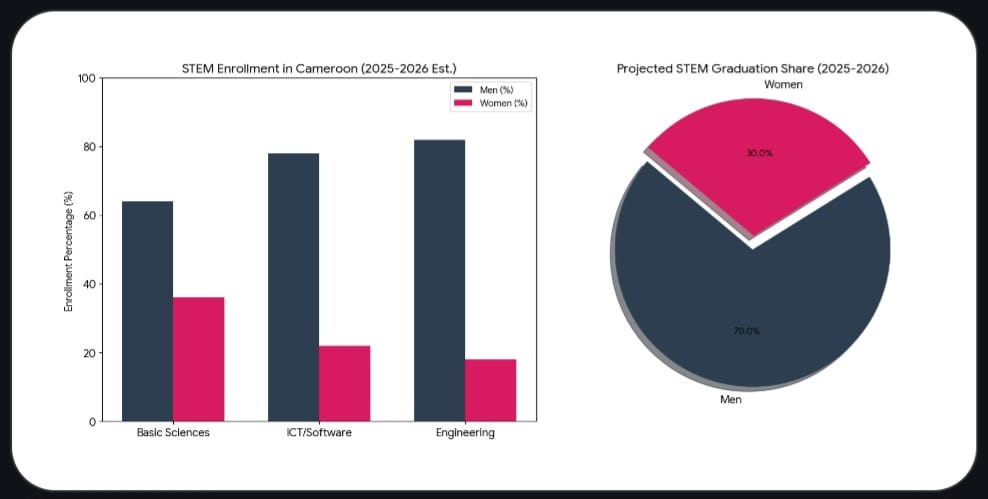
As Cameroon enters the mid-way point of the decade, the drive toward "Vision 2035" faces a critical hurdle within the lecture halls of its university systems. While national enrollment is climbing, Science, Technology, Engineering, and Mathematics (STEM) fields remain heavily male-dominated. Current projections for the 2025-2026 academic cycle, informed by MINESUP and UNESCO trends, show that while progress is being made in digital spaces, the "leaky pipeline" continues to filter women out of heavy industrial and engineering paths long before they reach graduation.The disparity is most visible when comparing different STEM disciplines. In Basic Sciences, men still hold a significant lead with a 64% enrollment rate compared to 36% for women. This gap sharpens into a chasm in Engineering, where women represent just 18% of the student body, a figure that has remained stubbornly low despite national industrialization efforts. However, a "digital leap" is occurring in ICT and Software Engineering; thanks to targeted bootcamps from organizations like Data Girl Technologies, female enrollment in these tech-heavy streams has surged to 47%, bringing the sector to the brink of gender parity. completing "hard" science degrees. Data from the National Institute of Statistics (INS) confirms that even when women do graduate, they face higher underemployment rates than their male counterparts.Closing this gap is now a prerequisite for national development under the NDS30 strategy. The numbers prove that where girls receive support, as seen in the near-parity of the ICT sector, they thrive. To ensure Cameroon's digital future is built by both its sons and daughters, the focus for 2026 must shift toward political will, specifically through the deployment of targeted scholarships, like the Fotabe STEM program, and internship placements that bridge the gap between the classroom and the workforce.