
Youth Entrepreneurship Shifts Toward Trade and Digital Services. New Trends Show Where Young People Are Building Businesses

By Tabe Glory
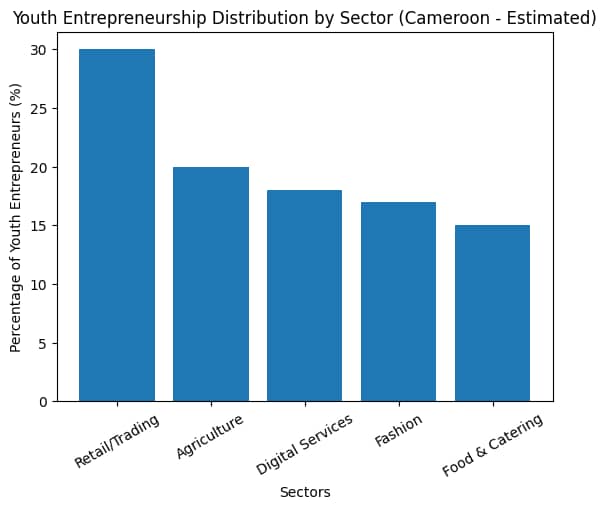
Retail and small-scale trading remain the dominant entry point for youth entrepreneurship in Cameroon, according to emerging trends in the informal and digital economy.An estimated 30 percent of young entrepreneurs are engaged in retail activities, making it the most common sector for business start-ups. The low capital requirement and ease of entry continue to attract many young people seeking immediate income opportunities.Agriculture follows at approximately 20 percent, with young entrepreneurs increasingly investing in small farming ventures and food production, particularly in peri-urban and rural areas.Digital services, including graphic design, social media management, and online marketing, account for about 18 percent of youth-led businesses. The growth of internet access and smartphone use has made this sector more accessible, especially in urban centres.Fashion-related businesses, such as tailoring and clothing sales, represent roughly 17 percent, while food and catering services make up about 15 percent of youth enterprises.Economic observers note that these sectors share a common feature: relatively low start-up costs combined with flexible operating models. This allows young people to enter the market with limited financial resources.The data reflects a broader shift toward self-employment among youth, driven by limited formal job opportunities and the expansion of digital platforms.However, challenges such as access to funding, business training, and market competition continue to affect sustainability.Despite these constraints, the figures suggest that youth entrepreneurship is becoming an increasingly important part of the country’s economic landscape, particularly in urban areas where innovation and digital adoption are growing.